Originally conceived in 2008 and featured on SABC national television, OneFinger™ is the world's first biometric identity verification bureau — now being re-built with cutting-edge AI for the modern cloud-native era.

In 2008, when most people didn't even know the word "biometrics," Peter-John Krauspe envisioned a world where your fingerprint would be your only identification. OneFinger™ was demonstrated on SABC national television and morning radio, showcasing how biometric verification could combat the epidemic of license plate fraud and identity theft in South Africa.
The original desktop application was limited by the technology of its era — before cloud computing, before smartphones were ubiquitous, before AI could amplify development. Now, OneFinger is being rebuilt from the ground up using the latest AI development tools, cloud-native architecture, and modern biometric technologies that didn't exist in 2010.
Modern technology has invented amazing products — but has spectacularly failed to protect an individual's identity. Every solution so far has been reactive, not proactive.
Criminals steal wallets, documents, and personal details to impersonate victims, opening accounts, taking loans, and running up debts — all in your name. In Q1 2008 alone, identity fraud cost SA businesses R276 million.
Sophisticated phishing emails and fake websites trick people into revealing passwords, PINs and banking details. US banks lose $12 billion annually to cyber criminals — that's 117× more than armed robbery.
Card skimming at retail points, cloned credit cards, and stolen PINs drain bank accounts. A local SA retail group loses R12 million per month to ID fraud at their point-of-sale terminals.
At one SA vehicle finance company, 60% of applications have documentation problems and 30% of applicants supply fraudulent IDs. Fake payslips, bank statements, and IDs are produced with basic laptops and printers.
Criminals impersonate you over the phone to change banking details, swap SIM cards, and intercept one-time passwords. No voice or phone-based verification can confirm the true identity of a caller.
Over 60% of South Africa's population are children under 18 with no ID book. Without biometric identity, they are extremely vulnerable to trafficking, kidnapping, and being taken out of the country undetected.
OneFinger™ addresses every avenue of identity fraud through its comprehensive Eight Pillars of Protection framework — each pillar representing a branded solution within the OneFinger ecosystem.
Face-to-face transaction verification at retail POS, medical facilities, and exam invigilation.
Anti-phishing protection — biometric consent required to complete any internet transaction.
Secure internet transactions using cell phone verification combined with biometric consent.
Secure exchange of goods, documents, vehicle keys, armouries, and evidence rooms with biometric handoff.
Document distribution protection via email — biometric or cell phone verification required.
Telephone Verification Number — confirms the identity and validity of all telephone interactions.
Child protection system for children under 18 without ID documents — combats trafficking and kidnapping.
Border control system for entry and exit points — controls porous borders and illegal immigration.
A seamless, three-minute registration protects your identity for life. After that, verification happens in milliseconds.
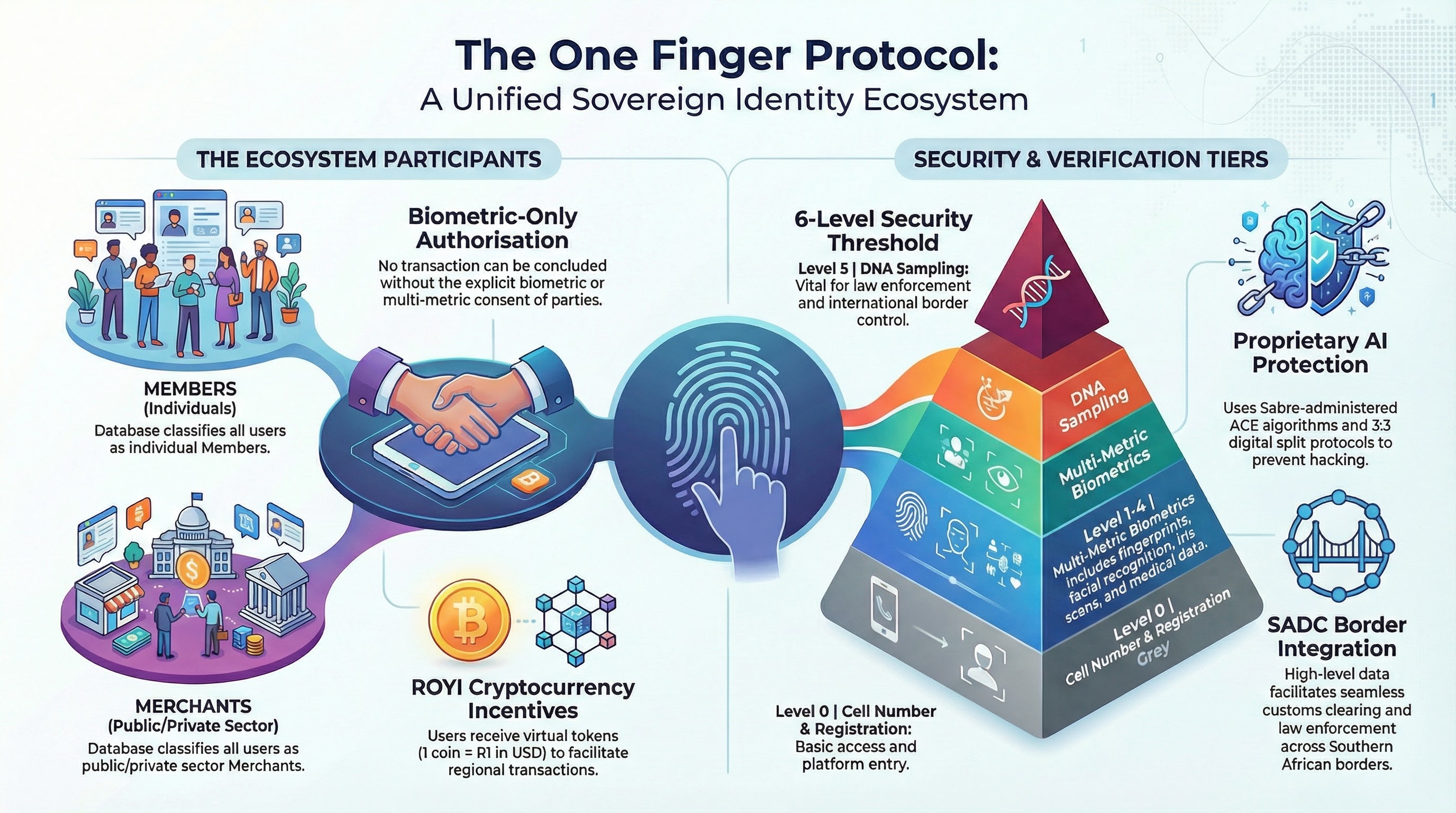
Visit any OneFinger-registered vendor. Your 10 fingerprints and a photograph are captured and converted into unique encrypted algorithms. No fingerprint images are stored — only mathematical representations that cannot be reverse-engineered.
Your biometric data is encrypted and stored on the neutral, independent OneFinger database. This data is never shared, never sold, and only accessible with your express biometric consent. Once enrolled, you never need to re-enrol regardless of scanner make.
At any OneFinger merchant, simply provide your ID number and place one finger on the reader. The system queries the database in milliseconds, retrieves your stored algorithms, and compares them against the live scan — confirming or denying your identity instantly.
The system returns a verification status: Verified, Certified, Disputed ID, Possible Stolen, or Not Verified. You receive free monthly audit reports and optional real-time SMS alerts.
The OneFinger network continuously learns. Every verification transaction updates the system's intelligence, dynamically adjusting security scores. The more the network is used, the smarter and more accurate it becomes — powered by modern AI capabilities.
When OneFinger was first conceived in 2008, cloud computing was in its infancy, smartphones were a luxury, and AI-assisted development was science fiction. The original desktop application was a visionary proof-of-concept — a solution that was ahead of its time.
In 2026, the limitations that held OneFinger back no longer exist. Using 5 AI development agents working alongside human specialists, the entire OneFinger platform is being rebuilt as a cloud-native, API-first ecosystem that can scale across the African continent and beyond.
The new OneFinger goes beyond the original vision — incorporating facial recognition, machine learning fraud detection, blockchain encryption, real-time API integrations, and hardware-agnostic biometric capture using entry-level devices. What once required expensive enterprise hardware can now be achieved with affordable, readily available components.
5 specialised AI agents accelerate development, reducing the need for 20+ human programmers while delivering superior results.
Modern microservices, containerised deployment, and global CDN distribution — technology that didn't exist in 2010.
Next-generation cryptographic security using blockchain principles for an immutable, tamper-proof identity ledger.
The proprietary ACE engine makes all biometric scanners compatible — no vendor lock-in, maximum flexibility.
OneFinger™ is not industry-specific. It protects identity wherever verification is needed — from retail to government, banking to healthcare.
OneFinger was showcased on SABC national television and live radio in 2010, demonstrating its capabilities to millions of South African viewers.
Peter-John Krauspe demonstrates the OneFinger identity verification system on national television, showcasing how biometric technology can combat license plate fraud and identity theft in the motor vehicle industry.
OneFinger featured on Morning Live Radio with Siki Mgabadeli, discussing the alarming rise of identity theft in South Africa and how biometric verification provides the only truly proactive solution.
Over 17 years of research, development, and industry experience — building towards the biometric revolution.
Peter-John Krauspe starts in biometrics and telecommunications. Co-founds one of SA's first ISPs (Pixie Internet), joins Persetel as their first network engineer, and helps erect one of the first 5 MTN towers in Johannesburg.
Begins developing Sabre Time & Attendance — the platform that would become the foundation for OneFinger. Introduced TCP/IP networking standards across SA corporate mainframe systems.
Sabre becomes the sole certified distributor for ZK Software (now ZK Teco) biometric hardware products for sub-Saharan Africa — establishing deep expertise in biometric hardware.
The OneFinger project begins in earnest — a desktop application designed as a proof of concept for biometric identity verification. The Eight Pillars of Protection framework is designed. Visionary, but limited by the technology of the era.
OneFinger is demonstrated on SABC 1 national television and Morning Live Radio. The concept generates enormous public interest but faces the reality that biometric technology infrastructure is not yet ready for mass deployment.
Sabre begins exploring cryptocurrency, encryption, and blockchain technology — understanding how these can complement and strengthen the OneFinger identity platform.
The journey into AI begins — using 5 AI development agents alongside human specialists to rebuild the entire Sabre and OneFinger ecosystem. Development that previously required 20+ programmers is now accelerated dramatically.
OneFinger is being re-built as a cloud-native platform with AI-powered development, modern APIs, hardware-agnostic architecture, and advanced features that weren't possible in 2010. The technology has finally caught up with the vision.
OneFinger™ is actively seeking strategic partners, investors, and early adopters to bring the biometric revolution to market. Join us in building the identity infrastructure of the future.